Managing Learning Centers: You Can Be At Every Center!

Have you heard of "Talk Boxes?" If you haven't, these are a classroom must have. With just a push of a button students can be independent at each center. If students can't remember what to do, they simply push the button to hear YOU give the instructions once again. What a great way to not only build student independence, but these boxes free the teacher to concentrate on guided reading/writing or math tables! Viola! With Talk boxes the quality of classroom life is improved instantaneously.


To top it off, there are many other uses for these devices. Children can quickly record their own voices providing opportunity for students to practice verbal and auditory skills. They can be used with games, displays, word walls, phonics practice,  information, etc.


These gadgets also come is a smaller version called "Talk Points."


Developmentally Appropriate - Child Centered Homework Packets: July

Tired of Worksheets? Are you looking for some great homework that is Developmentally Appropriate and Child Centered? You will love this NO-PREP option. These July packets will allow students to revisit important skills that should be mastered in order to be successful in the upcoming grade in school. This product is great from summer homework sent by teachers, parents looking to enrich learning in the summer, or homeschool parents that maintain a year round schedule.


Click on the links below to find these products at a low-price of $4.00 each on Teachers Pay Teachers.
 

Parent Volunteers: Recruiting, Managing, Maintaining

At the beginning of each new school year, teachers are excited to meet a brand new set of students and build relationships with a brand new set of parents. Engaging these parents as partners in their child's classroom can be a daunting task!

There are many barriers that prevent parents from volunteering. In fact, when I think of my own typical day, a large portion of what I have on my to-do list will be moved to the next day because of time restrictions. These restrictions are felt by all.

So how are you going to get the volunteers in?

This packet is intended to make that task easier than ever!


Table of Contents
Engaging Parents
Determining Volunteer Needs
Help Wanted: A Call to Action Letter
Parent Volunteer Survey
Volunteer Guidelines
How Children Learn
Discipline Guidelines
School Safety Guidelines
Volunteer Feedback Form
Class Party: Call For Help
Field Trip Volunteers
Volunteer To-do List
Thank you notes
Learning Center Sign-up Sheet
Learning Center Substitute/Fill-in Sign- up Sheet
Volunteers At-a-Glance
Volunteer Log
Volunteer Brochure Style

As Adults, We Should Be Advocates for All Children

There are many children who have adults as advocates in their lives. My grandson's mother is his advocate. When his kindergarten teacher told her at Parent Teacher Conference that her son's fine motor skills were too poor to do the work she was requiring she took steps. She met with the principal, she made the school's occupational therapist evaluate her son, she got him a 504 plan to ensure the school gave him 30 minutes of fine motor development every week. Then she signed him up for piano lessons. For many children, when they need help, the adults in their lives spring into action.

But not all children have advocates. Let me tell you about some of them:

Jacob and his little brother were raised by a single parent father who worked two jobs. Jacob became the caretaker for his little brother at the age of 3. Because they had limited modeling for speech, he and his brother made up their own language. When Jacob came to kindergarten, his Dad said. "I don't know what is wrong with him, he just speaks gibberish."

Emma spent the first four years of her life in a playpen with no adult interaction. She came to kindergarten only knowing three words: hungry, go, and no. At age 5, I was told by the speech teacher that her limited vocabulary would only slightly expand because the windows of language acquisition close completely by age 8.

Michael came to kindergarten with no regard for authority at all. He had been raised in an environment of doing whatever he wanted to because he was a boy. Because his mother was dominated by her husband, she had no control over him.

Elizabeth was in foster care. She had bright red hair and drew pictures of a smiling red haired woman on her papers, but she called her brunette foster parent "Mom". After three months, this foster mother asked for Elizabeth to be put in a different home because she was already overwhelmed with taking care of her own six children. She was shuffled off to a new family and a new school.

The causes that take away children's advocates are varied and personal, but the results of this gap in their lives are always devastating. As adults with the capability to do so, we need to stand in. When my daughter was in second grade there was a teacher in her school that bullied the children. When they didn't behave she would rap their heads with pencils or pull their hair. As my daughter's advocate, I made sure that this woman was not my child's classroom teacher, but she was still in the classroom occasionally during rotations. One day during these rotations, she pulled my daughter's hair. After hearing what had happened, I marched into the principals office and immediately demanded action be taken. His answer was that my daughter would never have to go into this teacher's room during rotations again. My child's rights had been addressed. For some, that would be enough. Not for me. And I told him so.

"There are children in that classroom whose parents are not in this office, and who will never come to this office," I told him, "but who still need an adult to stand up for them. I am not just here speaking for my daughter. I am speaking for all of them."

The teacher was reprimanded. The bullying stopped.

There are children who have advocates. Whose parents pay for private schools or drive their children to therapy or special brain development programs. Who start charter schools or put their children on special diets or show their babies vocabulary flashcards. Thank goodness for these parents. But sometimes, when these amazing people use their power to make their own children's lives better, those children without a support group are left behind. When there are problems around us, when others are suffering, it's not simply okay to walk away from it, taking our time, our resources, and our love with us. Our children need to see that as human beings, we take care of each other. We lift each other up. We climb the mountain together.

All children need someone.

They need you.

Creating Portfolio Memory Keepsakes

A portfolio is a sampling of information relating to a child’s developmental progress in a school (or home) setting. Portfolios contain work samples that are representative of where a child is at a particular time. It clearly shows development as it continues throughout the school year. A portfolio is an effective assessment tool that authentically documents a child’s progress and serves as a great reporting tool as well.

I have used portfolios for about 23 years now. They have not only proven to be effective assessment tools, but I have found them to be very popular with parents and students alike. Furthermore, they continue to be loved throughout the years. (I have had students graduating from college bring them back for me to sign)!

Memory books are also a great tool to keep “favorite” school memories alive. We have merged the memory book idea and included it as part of the portfolio system. This keeps the documentation of student growth fun and interesting to the student along the way.

This product has been built for your flexibility. 


There are seven choices of portfolio covers and binder end tags provided for all grades -- Preschool, Pre-K, K and 1st. There are color and black and white options included. 

The product is divided into sections: Beginning of the year essentials, month by month work samples, pages to use throughout the year to document memories, and an end of the year section. 
We extend this basic portfolio template by including math and science work samples.
Using these two products in tandem, adding photo pages such as the ones below (I add about 2 a month), you will have a treasure for your students to take home at the end of the school year.


Teaching Young Children To Write

Early in my career I was a writing rebel. I was told by many of my peers, "Young children cannot and should not write!" I pressed on and taught writing to my students covertly anyway. It was simply frowned upon to start any formal writing until second semester. And then you were only to teach modeled or structured writing.

Now, educators concur that reading and writing go hand in hand and are an “…interactive process.  There is a dynamic relationship between reading and writing and each one influences the development of the other…” (McMahon & Warrick, 2007, p. 159).

Back in 71 Million years ago they was Dinosaurs
Young children can write and this writing should occur daily in the early childhood classroom. In fact, most students will write before they read! “Over the school year, students’ writing develops…with increasing levels of sophistication of vocabulary, syntax, and stylistic features” (Bailey & Heritage, 2008, p. 159).  As writing develops, teachers will clearly see knowledge of phonics rules as well as a demonstration of graphophonemic knowledge applied to writing, and by observing the writings, great insights can be gained. 

Moab Day! Moab is hot and very weird 

Students need to experience genuine purpose and different types of writing in a risk free environment. Students must be empowered with confidence that they are capable of writing and possess the knowledge that their efforts are accepted and authentic. This happens when students are given the skills necessary to build independence. Students will flourish in a classroom where the physical, pedagogical and emotional environment supports literacy.  Research supports littering the environment with print and providing students opportunities to read and write their surroundings.


Young children can write! Consequently, writing in many forms should occur daily in the early childhood classroom! 


References

Bailey, A. L., Heritage, M. (2008). Formative assessment for literacy. Corwin Press: CA.
McMahon, C. and Warrick P. (2007). Wee can write. Northwest Regional Educational Laboratory: ORE.

Scaffolding emergent writing in the zone of proximal development. Mid-Continent Regional Educational Lab (MCREL. Retrieved August 19, 2008 from http://www.mcrel.org/

If you are looking for a great product to teach reading, please check out our best selling: "Writing in the Early Childhood Classroom." It is newly updated. It not only contains tips, strategies, hints, and secrets for writing success, but step-by-step lessons and 172 pages of writing prompt choices. Each prompt has three choices to meet your needs.


Clip Art: Free Offer!

If you looking for some gorgeous, clear images for design or print, you should check out yayimages.com. The best part? They offer 2 weeks of access for free! What a great opportunity to see if the sight meets your needs without making a commitment. And, my favorite part, no credit card is necessary and the free trial will cancel automatically. Simply email Peter Rua at peterrua@yayimages.com. He will set you up.

Empowering our Students

This summer children of middle and higher income parents are signing up! They are signing up for art classes, music classes, cooking classes, STEM classes, gardening classes, drama classes, T-Ball, soccer, tennis, swimming and more. On top of that they will participate in family vacations, trips to museums, libraries, and zoos. These trips will reinforce, expand, and enrich the learning of these lucky kids.
But such is not the summertime experience of our low-income students. It was not my experience either. My parents could not afford to give me these kinds of life experiences, but there was a gift they gave me that made up the difference. They empowered me. They gave me the strength of character to know that I was worthwhile and capable. The inner strength to laugh at the high school counselor who told me that I shouldn't go to college because I wouldn't succeed and determination to go out and prove him wrong. The kind of internal light that Mindy Kaling showed at Sundance when asked what drives her to continue, even when she knows their are roadblocks ahead.

(image from Beauty Redefined)

As a classroom teacher, I know that my students will come with disparity of experiences. The best tool that I can arm all of the children with is empowerment! Many years ago I attended a seminar that changed my thinking towards student academic success, and made me reflect upon my own personal experiences. I was taught that students from even the most merger of circumstances can thrive. I remember a video of a student of two alcoholic parents and devastating living circumstances that continued to flourish as a student in her classroom. How was this so? The student was empowered! The following video also demonstrates how students can thrive, even in the most difficult of circumstances, if they feel the inner light of empowerment:


So, how do we empower our own students? Here is my top 10 list:


  1. Teach children to think for themselves: to make positive and informed choices.
  2. Teach children how to solve problems.
  3. Teach children to feel good about themselves.
  4. Encourage laughter and foster a sense of humor.
  5. Allow children many opportunities to feel the benefits of intrinsic rewards, while limiting (or my choice, eliminating) extrinsic rewards.
  6. Teach children how to ask questions.
  7. Teach children to be curious, discover, and to create.
  8. Teach children how to make informed choices.
  9. Set rules, boundaries, and have high expectations.
  10. Teach students resiliency: to be decisive and have stick-to-it-ness.
Students who become empowered, resilient beings, are able to overcome insurmountable obstacles. Our job as teachers is to lead them to that end. To fill our lesson plans with opportunities of character development and empowering opportunities.


Addition and Subtraction Kindergarten Worksheets

If you are like  me, and looking for more ways for your students to add and subtract fluently within 5, you might check out these worksheets. For only $3.00 you will have 10 addition and 10 subtraction worksheets ready to give important practice to your young learners.


Poverty and Student Academic Success


Throughout my teaching career I have made many home visits, but one, in particular, stands out. A student of mine had been in an accident and I visited his home armed with some books, a class photo of his friends, and a hug. The home I entered was a tiny, cramped space occupied by not one, but many families. As teachers we know that despite our best efforts in the classroom, much of a child's future success has been predetermined by his socioeconomic status. It is a wall that we as teachers are continually chipping away at, but it is a monumental task. As teachers, we also know how devastating living in poverty is to a child. Poverty causes negative changes in the brain . Poverty causes stress. It is a source of depression and anger, illness and crime. With such devastating effects, why don't teachers have more allies in the fight against it? Especially when it has been shown to be the cause of any so called "education crises" in America. As reported by USA Today, "When you measure the test scores of American schools with a child poverty rate of less than 20%... they outperform every nation in the world." 

So why have we become mired in nowhere "solutions" like "No Child Left Behind" and "Race to the Top"? Why has the answer to perceived school failure become Charter Schools and Vouchers? Why are we splitting our resources and allowing ourselves to continually fail our children because we are avoiding the issue. Teacher Tom thinks it's because, you can't make money off of solving poverty, and perhaps the reason really is that simple. Big box curriculum companies certainly stand to lose millions if we shift our focus from testing to improving lives. Politicians certainly make more progress when they introduce legislations that is labeled "education reform" than when a bill is meant to improve the lives of those in poverty. In my own state of Utah, a bill called the "Healthy Utah Plan" that would improve the health of children in the state may not even be given a hearing in the state house. We know the root of our education problem in this country, and yet we are hesitant to create solutions.

As teachers, we need to remember that we are a source of stability for these children, and that their educational success depends more on the life skills they learn from us, than from the test score they receive at the end of the year. These children are dealing with unbearable levels of stress in their lives, and, therefore, they desperately need a classroom free from anxiety. A classroom where they feel safe. We need to teach them the proper social skills through play based interactions. If we do not, they may never learn these skills at all. We need to love these children. They need love. Their parents need to know that their child is loved. It may sound trite, but love is the bridge that can create opportunities for these children and their families, and until we can rally the kind of social reform that can put an end to appalling percentage of children who live this way, love is going to be these children's lifeline. We must extend it to them. They are drowning.


Keep Kids Reading This Summer

Read, read, and read some more....that sounds like a wonderful summer! Our students may not agree, but they might be tempted to read a little every day with the right resources. 

First on the list should be the little paper books that you have used for guided reading. These books are often “old favorites” that students will return to again and again. With these books, students can review sight words and practice fluent reading. 

To keep students interested in reading, however, they need access to new or different stories. These can take the form of books checked out from a public library or purchased at a bookstore. Technology can also provide access to new titles.

Farfaria is an app that allows members to read one free book per day. (For unlimited access, parents can pay a monthly, yearly, or lifetime fee.) The books are divided by subject, theme or genre; each division includes books representing a wide variety of reading levels. Students can choose to read the book or listen to it while individual words are highlighted. Simply put, children love to read using this app. It has over 1,000 books that are aligned to Common Core reading levels. And, new titles are added weekly! Additionally all books are professionally narrated to aide students in listening comprehension.

Reading is critical to success in school. Encourage your students to keep reading this summer to maintain reading skills...and to have some fun doing so!   

End of the Year Song: I Like School

This is one of my favorite songs to use with my kindergartners. In fact, I like it so much, I use it to both begin and end my school year. 


Here is a group of school kids singing the song. 


End of The Year Celebration Songs

Several years ago I ran across a treasure! Her name is Nancy Stewart. If you are an early childhood educator and have not yet been introduced to her fabulous, age-appropriate music, I am happy that I can introduce her to you! 

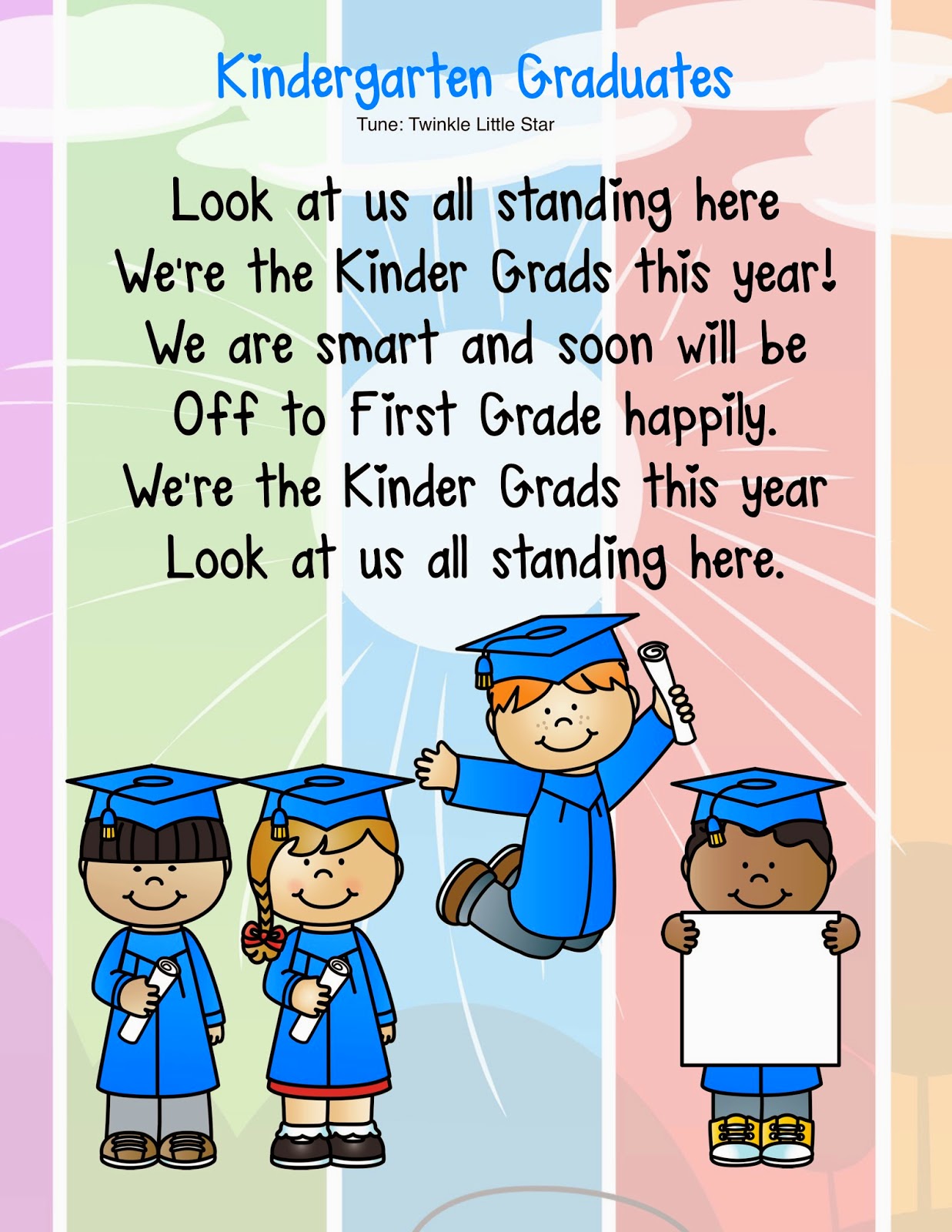
We are using this song in our Kindergarten Graduation. It is adapted slightly from Nancy's original to make it easier for our kiddos. You can download the sheet music and mp3 of the version with words or instrumental selection for free. Yep for free. She offers loads of free, appropriate songs. You will love this site! Please, enjoy this free song poster.

Summer Homework Calendar & Free Song Poster

This is one of my favorite, most useful products. As a parent, I wanted summer homework that was scheduled, quick, and meaningful. From that desire, I created this Summer Homework Calendar. You can pick it up at the TPT Store for only $2.00.


And, as promised, here is a third song poster from our Kindergarten Graduation. Enjoy


Graduation Craftivity, Diplomas, And a Free Song Poster

 Looking for a fun end of the year activity and/or craft? Check out our updated Graduation packet that includes instruction for the craft and bonus graduation diplomas and invitations.


Also, as promised here is another free Graduation/End-of-the-Year poster. This great Jack Johnson song is a great song for all grade levels.


Here is a class on youtube singing this song in sign language.


Play is Fundamental

Children's play is not a luxury. It is imperative to their development, health and well being. It also has countless benefits on cognition. Play allows student 's opportunity to be innovative, experiment, create and discover. Simply put, play equals learning!

I ran across this great video on play. I think it is the best I have seen.

If you are looking for Thematic Units filled with play-based games, check out our Thematic Units. Here are a few, we offer over 50.

End The School Year in Song

This great end of the year song, written by Steven Vogel, can be found here. The children enjoy singing its thoughtful melody, and certainly washes the brains with endorphins.

We are preparing for our kindergarten graduation, and this is one of our songs. I will be posting a free poster for each of our five songs, one each day for the next five days.

If you love adding sign language to your classroom, visit Signing Savvy. This is the go-to sign language resource. I also like Baby Sign Language as it simplifies the process. And then of course, if you get real serious you can invest in Signing Time, a program that builds language and vocabulary as well as signing.

Whether you are planning a graduation like my kindergarten block, a celebration, or simply want some great end of the year songs to celebrate your classroom community, remember to stop by daily to pick up your free poster and glean a few end-of-the-year hints and/or projects along the way.

Finding The Best Ipad Apps

Because there are a lot of poor games out there, and many are based on the kind of operant conditioning described in the video below , they are a huge draw for children without having much reward, and they are often the kinds of games our children might ask us for. Sometimes it's hard to find games that are actually worth the time our kids are going to spend on them. What follows are some of my favorites. I haven't been paid by any of these games to promote them. I just think they're good.


Hungry Guppy

It's difficult to find an app that really works kid's number sense. That's why I love Hungry Guppy and Hungry Fish so much. They are made by Motion Math (that makes a whole slew of great math games for older kids). Hungry Guppy is appropriate for Preschool, Kindergarten, and First Grade children, and Hungry Fish is for First Grade and up. Hungry Guppy teaches children key foundational math skills, such as the part/whole relationship of numbers and their hierarchical relationships. For a glimpse of what you get with this app, check out this video:


Subitize Tree

Subitizing is an important skill for young children. It is the ability to visually recognize numbers by mentally grouping them. This is a great game that hones this skill. A child must quickly recognize the number shown in order to free the animals. It has different difficulty settings which makes sure that children can be challenged and not frustrated as they develop the skill. Both my 3 year old and 6 year old enjoy this game at different levels.


Duck Duck Moose

I love app developer Duck Duck Moose. All of their apps are well made, adorable, and creative. My younger kids love their nursery rhyme apps and my older kid is a fan of Moose Math. I don't think you can go wrong buying something made by these guys.


KneeBouncers

Sometimes baby is going to want a turn at the iPad, or need a phone distraction, andKneeBouncers is the best I've found. When baby touches the device's screen, bubbles pop, colors change, bells ring, and vehicles drive by. It works on your computer too; if baby likes to play with your keyboard.

Monkey Preschool

The Monkey Preschool series by THUP games is another series where every game is a winner. All of my kids have loved these games while preschool age, and they've learned great skills too!


Letter School

Letter School is a handwriting app. It's been a great app for all my kids, and especially for my second son, who learned all his letters by the time he was 2 from playing this app. The novelty of the game has worn off of my 6 year old, however, despite the fact that he still needs the practice.


Handwriting Without Tears

Based on the fantastic handwriting program, this is an excellent app for teaching proper letter formation. However, children probably won't be intrinsically motivated to play this one, so it's place is probably more instructional than recreational.

Eddie's Number Party!

This game by Scientific Learning, is a wonderful game to teach preschoolers pre mathematical skills. It also has a fun storyline and... PUPPIES! And what preschooler wouldn't love that?


Originator

Originator is the creator of the apps, Endless Alphabet, Endless Numbers, Endless Wordplay, and Endless Reader. All of these are engaging, adorable, and informative. You need to watch the video to get and idea of just how adorably these games have been put together.


This post originated on Lyndsey's Blog:  Mamma's Tots.

Technology In the Classroom

Technology should be deliberately used in the classroom. You can evaluate if you are effectively using technology to impact teaching and learning by using the SAMR model. The letters represent: Substitution, Augmentation, Modification, and Redefinition. 

Substitution: Technology is sometimes used just as a substitution for something that we already have - reading or listening to a story on a computer or an i-Pad instead of reading a book or listening to a story from a listening center. This is a good starting point for technology, but doesn’t go far enough. 

Augmentation: Technology can make a report or project a little better. If you type up a report on a computer and then use spell check, you are using technology to augment your work. Again, a nice feature, but not enough to justify great expense.

Modification: At this level technology begins to transform the educational process.  Students still use traditional skills such as writing, but they complete assignments with technology. In kindergarten, a student may write about a subject, then record the story or sentences on an i-Pad. The accompanying illustrations can be photos of the student’s drawings, clip art, or other digital images. The report or story can be shared with classmates or parents.

Redefinition: A step up from modification, redefinition also transforms learning. At this level, technology allows for the creation of tasks that once would have been impossible and even inconceivable. Students can collaborate on a project; it can include student writing and pictures put together as a slide show with background music, video, and student recordings. The possibilities are endless, especially as students gain experience through the years.


John Dewey said, “If we teach today’s students as we taught yesterday’s, we rob them of tomorrow.” Technology is a part of the future for our students; take advantage of it to transform learning in your classroom.

Printfriendly