


Showing posts with label Play. Show all posts
Showing posts with label Play. Show all posts
Setting Up the Classroom
As educators are setting up their classrooms for a brand new school year, may educating the Whole Child be foremost in their thoughts. The areas for discovery are the most important areas in our classrooms!


Play is a Training Ground for Creative Thinkers

When I was a young girl I was raised on a dairy farm in the “Hired Hand” house. Consequently, we did not have a lot of money, and I certainly didn't have many toys, but there was one thing I had a lot of and that was opportunities for discovery, play and access to the “Bookmobile.”
I remember every Monday at 4 p.m. I would head for the Bookmobile that was located about a mile away. Generally I would ride my bicycle down that bumpy, gravel lane as fast as my legs could carry me. I was so excited to get my next volume of Nancy Drew, Little House on the Prairie, or any of the other special treats the librarian had tucked away for me.
I would return home, read, and read, and then dramatize the book. Yep, I acted out the entire book using anything from dolls to pencils, or just my imagination. From this reading and acting ritual that I developed at a young age, I did not realize that I was doing all of the activities necessary to become a fluent, comprehender of text. In fact, I learned about the world without one worksheet or test to tell someone what I had learned in a passive manner.
Thank goodness that my life’s path has been that of a squiggly line. I am grateful for the opportunity to grow up on that dairy farm where I could be a rodeo queen one day, and a detective solving crimes the next. Thank goodness my mom couldn't afford the summer skills workbooks of today.
Play is Fundamental

I ran across this great video on play. I think it is the best I have seen.

If you are looking for Thematic Units filled with play-based games, check out our Thematic Units. Here are a few, we offer over 50.
Playing with Blocks in Kindergarten

Cognitive benefits are further enhanced if particular tasks are given at the block center. This week I will be placing some small vehicles with variances (trucks, cars, buses, etc.) at the block center and asking the students to build a track with ramps to race an opponent. This is always a favorite activity. You can just feel the brains power working at this center. --Keep Play in K!
Meeting Common Core Standards through Dramatic Play
 |
| Kathleen's castle! |
Do you have a playhouse or dramatic play center in your room? Many principals, as well as parents and even kindergarten teachers, don’t understand the purpose of a playhouse. They hear the word play and understanding ends there!
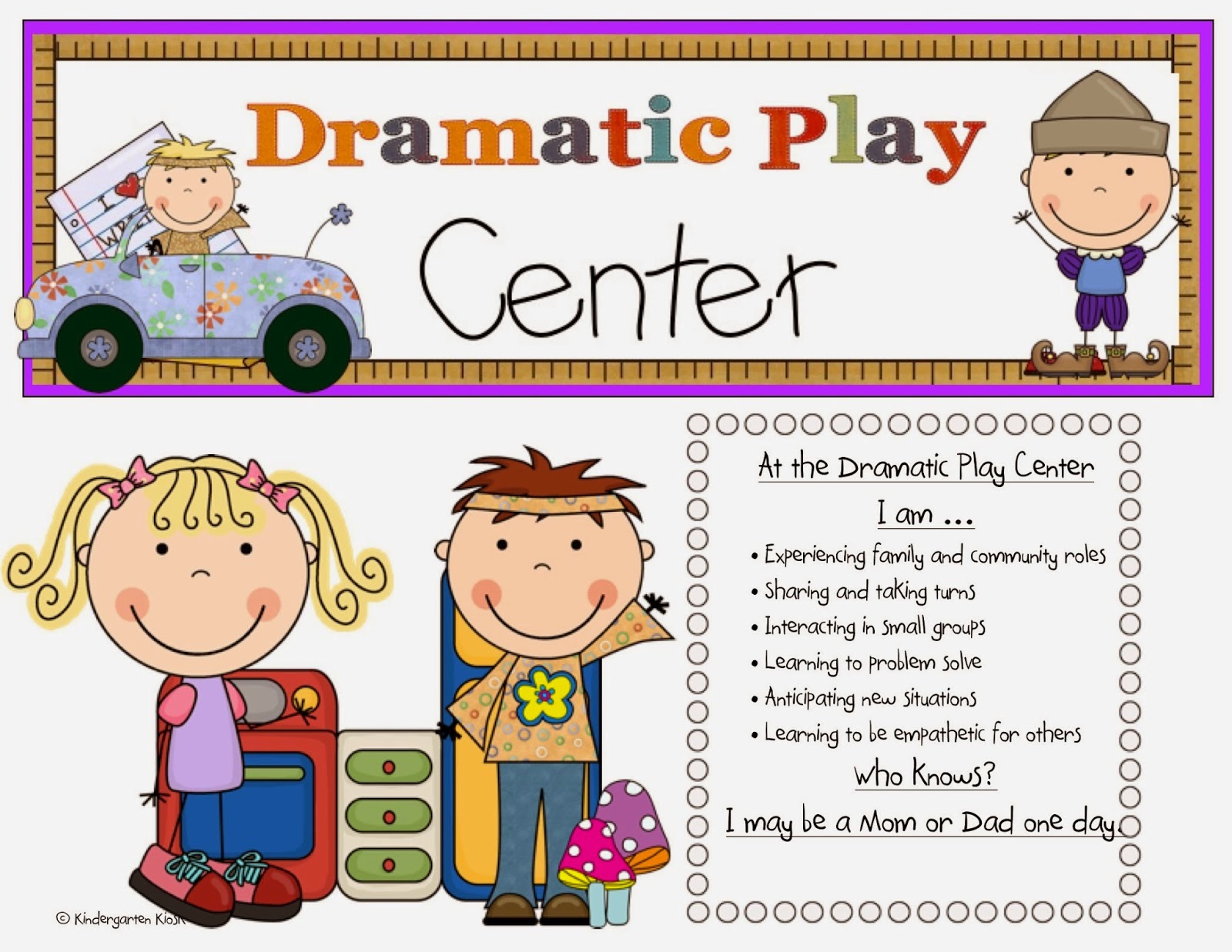
The value of a dramatic play center cannot be overstated. In this center, students can take on the role of mom, dad, baby bear, chef, doctor, teacher, or post master. Shy students are often more willing to participate when they can “be” someone else. Students have multiple opportunities to take turns, share, and negotiate as they play together. Language and vocabulary development are increased through speaking and listening in the center, especially if it is changed throughout the year to be a hospital, restaurant, a 3 Bears’ cottage, etc.
Reading and writing skills can be practiced in the playhouse. Students can write restaurant orders, grocery lists, or letters to mail. They can read in a hospital room or a playhouse kitchen. With alphabet or number flashcards Baby bear or Goldilocks as well as students in a school room can review letters, sounds, or numbers.
In order to capitalize on the benefits of a dramatic play center, include a variety of materials for students to use, change the “scene” occasionally, and determine which standards are best addressed by the activities that you anticipate in the playhouse area. Check out the standards for Speaking and Listening, Reading Literature and/or Informational Text, Reading Foundations, Writing, and Counting and Cardinality. Post some of the specific standards that are being met or include the standards in your lesson plans. In addition, or as an alternate, post an explanation of the learning benefits of the dramatic play center.
Whether you have an actual playhouse or a defined area in your room, students can thrive in a dramatic play center. Deliberately Incorporate this center in your weekly plans to meet learning objectives and state standards.
Here is my learning center poster that is posted by my playhouse.

Justifying Kindergarten Play
 |
| These signs are available for each center to justify learning through play. |

Because my, "I am in Kindergarten Sign" that I posted on Facebook a few days ago has now reached over 120,000 reaches, I have renewed hope for the developmental appropriateness of kindergarten! Yes kindergarten teachers, we can do it! Let's take back kindergarten!
We can keep the "Learning Through Play" in kindergarten. And, we can keep this play, discovery, movement, and excitement while even teaching the Common Core Standards! It is the presentation of the material that makes the difference.
Instead of desk sitting, carpet sitting, and worksheet doing, these concepts can be taught by using proven early childhood methods: games, experiments, choice, dramatization, retelling, and many more. One comment on my post stands out...
"I learn through play! Sitting makes me restless and I end up in time out. PLEASE LET ME BE A CHILD!!!"
Valentines Dramatic Play and Writing

Probably one of my favorite Dramatic Play opportunities of the year in our playhouse is The Valentine Post Office.
I purchased the postman costumes years (and years) ago from Lakeshore. They are adorable, and consist of a jacket, a hat and a mailbag. If you do not have costumes, you can find many templates for postal worker hats online and simply make your own as a headband. Or, do the Post Office without costumes.
Next, fill the playhouse with TONS of writing paper. I have scraps of paper, paper cut as hearts, paper that is ran as cards, and so-on. Then add some markers, pencils, crayons, stamps, or anything else you can think of.
I then give the students one main rule. The post office is for writing letters! You can add pictures to finish your writing, but you must write first!
This is when my independent writing moves to a new level, love it!


Teach Common Core Math Through Dramatic Play
Dramatic play offers unprecedented opportunities for teaching Common Core Math concepts through authentic experiences. In fact, when asked to work on math skills in the context of a play situations, students are always able to work at a level above their normal skill. To meet the high academic demands of the 21st century, play will be critical to student success, scaffolding their learning in a way that allows them to be successful.

Table of Contents
Dinosaur Museum: Decomposing and composing shapes
Post Office: Understanding the relationships between numbers and quantities
The Costume Shop: Know number names and the count sequence
Pizza Restaurant: Comparing numbers
Ice Cram Parlor: Represent addition and subtraction
Chocolate Shop: Composing and decomposing shapes
Trip to Space: Classifying, sorting, and charting data
The News Station: Answer “How many” despite the arrangement of objects
Santa’s Workshop: Identifying teen numbers as groups of ten and some ones
Knight’s Castle: Describe and compare castles by their measurable attributes
Farm Fluency: Adding and subtracting fluently within 5
The Bakery: Composing and decomposing shapes
Three Bear’s Cottage: Describing objects in the environment using names of shapes and position words

Dramatic Play
 When I moved from 1st grade to kindergarten I was shocked at the lack of dramatic play in kindergartens here in Utah. When I asked a teacher why they didn't include it, she said, "with our curriculum and only half a day, I simply don't have time for it". While I can see the concern there, I maintain that I don't have time to leave out dramatic play. Play has so many benefits for young children and it is becoming a lost art of childhood. I can't imagine my program without it!
I just changed my dramatic play area to the 3 Bears Cottage. Today the children acted out the story in their own creative ways. One group had three daddy bears and one Goldilocks. It was wonderful to see the way they worked out their own problems to satisfy everyone's wants and needs.
Here are more benefits of play:
Stimulates Thinking:

Dramatic play will stimulate children's minds and promote advanced intellectual development! It also is a great way for children to expand experiences through reenacting events. These reenactments allow experiences to make more sense and have more meaning, paving the way for future academic success.
Define Social Roles:
Dramatic play helps children learn social roles and rules, and offers time to practice such social morays as sharing, taking turn, communicating to inform or persuade, and resolving conflicts, and cooperation.
 Creativity and Imagination:
When children are engaged in dramatic play, they can be anyone that they want to be and can even do the impossible! This type of play encourages children to use their imagination and to be creative, as there are no limits. This creative ability will aide students throughout their lives as they become creative and learn to solve problems.
Builds Emotional Strength:
Young children have a hard time understanding and controlling feelings. By engaging in creative play, children can learn to manage and understand certain feelings by re-enacting episodes. Dramatic play can also enhance children's ability to empathize with other people.
Develops Language:
Dramatic play encourages expressive language. Children are motivated to convey their wishes to others and speak from the perspective of their pretend roles. In fact, it is often through dramatic play that shy or withdrawn children first begin to express themselves through language.
For more information on the subject. Check this out:
NPR on play
Miami University on play
Scientific American on play
Subscribe to:
Posts (Atom)