Parent Teacher Conference Reporting Form


Want an easy form to help with reporting progress to parents? Check this out at our online store. Includes a writing rubric to track students along the writing continum.


The Five Senses

We took a fall field trip to the local Youth Garden Project and enjoyed a great lesson on the Five Senses.


Halloween And Non Halloween Kindergarten Activities

Are you looking for some great October (Halloween and Non-Halloween) options? Check out some of our popular October products. (Most are adaptable PreK-1). 

Two of these activities are FREE!


Building Opportunities For Independent Practice


Whether you have helpers in your classroom or not, students must have time for independent work. They need time to explore, experiment, and investigate. They also need time to practice skills and strategies that you are teaching them. Along with modeling and guided practice, independent practice is a crucial component of instruction.


At the beginning of the school year, independent practice can be very procedural. Students can paint, play with playdough, use computers, put puzzles together, trace names, listen to stories, play in a playhouse, explore at a science center, etc. The skills and instruction needed for these activities is minimal; your focus can be on how to work through problems (e.g., what to do if the computer quits working), how to share materials, and how to pick up. Through these independent centers, students come to understand how to work without the immediate guidance of an adult.

Within a short time, your independent centers can include some skill practice. Students can play syllable, rhyming, alphabet, and number games. It is important that students understand exactly how to complete the activity. To that end it helps to play games that fit similar formats and follow the same rules and procedures. 

Independent practice is only beneficial if the students practice the skill correctly.  Before presenting a skill as an independent center, provide multiple opportunities for guided practice featuring that skill. If possible have at least one student in each group who has mastered the skill that the students are practicing, also.

If you are looking for independent center ideas, check out any of our units. Each unit includes games that you can play with your students in small or large groups; later they can play these same games independently. 

One of our goals in education is to help our students become independent learners. Using independent centers in your classroom will help you achieve this goal.


Bugs and More Bugs


With over a million different species, insects cover the earth! Although not loved by many teachers, students are usually fascinated with insects. They make an ideal subject for study at almost any time of the year. 


The opportunity to observe insects will capture the imagination and attention of your students and takes very little effort. Just provide a few plastic or real insects and a magnifying glass. Plastic insects make perfect models for close examination; live insects in see-through plastic containers add a dimension of reality to this science unit.

The added bonus to this high-interest subject is that you can meet math and reading objectives while learning about insects. Check out our Insect unit for games, activities, and other ideas.


McGraw Hill Reading Wonders for Kindergarten


Are you looking for some great flashcards to supplement your Wonders Reading Program? 

Most of our products: Thematic Units, and Writing Center Anchor Charts and Activities are build around the Wonders Program.

Additionally here are a few more "Wonders" items:


Sight Word Flash Cards or Game Card Sets:

This set contains 21 sets that can be used as flashcards, write the room cards, game cards, fluency cards, writing center cards, and on and on.

Star Word Cards
Basketball Word Cards
Apple Word Cards
Space Word Cards
Clover Word Cards
Pocket Word Cards
Piggy Bank Word Cards
Leaf Word Cards
Valentine Word Cards
Framed Word Cards
Fish Bowl Word Cards
Gumdrop Word Cards
Beehive Word Cards
Bathtub Word Cards
Little Chick Word Cards
Horse Word Cards
Lamb Word Cards
Mud Word Cards
Penguin Word Cards
Halloween Headstone Word Cards
Panda Bear Word Cards

This product allows you to build a "Wonders" Sight Word Wall

This product allow students practice with "Wonders" Sight Word Sentences.


Book Boxes: And Guided Readers.


Beginning readers need a lot of practice; research has shown that fluency improves with repeated readings. Giving students copies of guided readers to keep at home provides additional practice opportunities for them. 

A home reading program will be more effective if the student has a way to save or store the books. A book box is a great at-home storage solution. A book box can easily be made out of a shoe box - either a regular shoe box or a purchased plastic shoe box. Your students can decorate the boxes at home. They can be elaborately decorated or just covered with stickers. 

To encourage completion of this special homework project, have a Book Box Show and Tell. After the students share their boxes, send them home again with one or two books. By the end of the year, the box will be overflowing with books that your students can read!

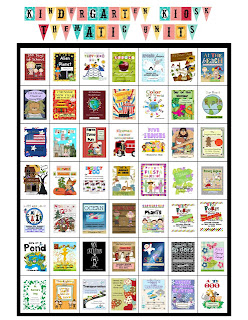
Kindergarten Kiosk offers a wide variety of guided reading sets and also includes at least one guided reader with all 50 of our thematic units.


Colors and Early Learning


Whether you’re experimenting with color-mixing in science, completing patterns in math, or enjoying stories in reading, colors are an essential part of the school curriculum. Color recognition and color word recognition are skills that students will need to be successful in pre-school, kindergarten, and first grade.

Because colors play a pivotal role in the curriculum, it is important that some beginning school activities center around colors. For students who do not know all of the colors, this is their opportunity to learn them. Students who recognize some or all of the colors can experience early success in school, which will help shape their attitudes towards school and learning.

It’s easy to incorporate a color review in your classroom. Talk about colors as your students paint or color a picture. Sort buttons or beads by color. Play a name game based on the song Mary Wore Her Red Dress by substituting a student’s name, the corresponding color, and something that student is wearing. Put up the words to Mary Had a Little Lamb, then substitute a color word card for the word white. 

The ways to review and/or learn colors and color words are endless. For more ideas, check out our unit
  Color My World. Other materials available from Kindergarten Kiosk include Color Songs and Worksheets, Color Word Handwriting and Color Word - Word Wall, and Color Themed Emergent Guided Readers.


Using Rock, Paper, Scissors for Classroom Management

It's important for children to be able to have the skills to monitor their behavior and solve disagreements. It's not unusual for children to want an adult to solve their interpersonal problems for them, but what they really need is an adult to teach them a strategy to use to solve the problem on their own. Strategies like, "Let's roll a die to see who will have the first turn" or "Whomever can throw the ball the highest gets to play with it first".

One strategy my students always enjoyed was playing "rock, paper, scissors" but many of them had difficulty making the hand gestures and many more had trouble with the timing (and not changing the gesture according to what the other player is doing). Using a card deck to play the game solves these problems.

The Rock, Paper, Scissors card deck is available for free at our Teachers Pay Teachers store. You can use the cards in several ways. The teacher can keep copies of the cards that the students can access when they need to solve a problem or each child can keep a set in his/her desk. We hope they help you empower your students to solve problems on their own! The beginning of the year is a great time to start teaching them how.


Time Out and Managing Classroom Behavior

I will never use behavior charts in my room. Why? 

1. Behavior charts are simply a tool for recording or tracking behavior, not a method to teach correct behavior.

2. Behavior charts cause unnecessary anxiousness in young children! The majority of young children have the innate desire to behave, but at times their natural curiosity, exuberance for life, or limited attention span halts their ability to adhere to the cultural "green" expectations of school. If they are constantly threatened with the looming yellow and/or red cards, their natural desires to learn and discover are negatively impacted.

3. The chart lays in wait! It is there glaring at students, expecting them to misbehave! Charts set the stage for misbehavior...." I expect that you will misbehave, so here I, am ready for you!" "I WILL catch you!"

4. Behavior charts are negative and embarrassing. Students do not always understand why they are asked to turn their card or move their clip to red. "What did I do?" Young children are not always savvy to the expectations of their teacher "in the moment."

5. The "Blue Birds" of the classroom also receive negative consequences. Always staying on green can drive the anxiety of perfectionism. I have always been on green, so I must ALWAYS stay on green!

Want a great alternative to the charts?

This is my Time-Out Tower! It is simply a large one minute sand timer. (I purchased it at Lakeshore) When a student continues to misbehave (such as poking a friend on the carpet, time and time again), I simply look at the student, make the sign for time out, and continue teaching the class. The student quietly moves to the time-out tower and flips it over. There they stand for 1-minute. At the end of time they return quietly back to the carpet/table/desk and join the group. No embarrassment, humiliation, or wondering why. The 1 minute gives the student time to reflect and come to a decision to adjust their behavior.

Really, this works like a charm! I had a principal once tell me that she was amazed! I sent a child (yes the same one) to time-out twice during one of my evaluations and did not miss a beat in my teaching. Not one child paid attentions to the time-out, they simply continued to be engaged in the lesson. The child adjusted her behavior (after her 2nd time-out) and joined the group with a positive smile, ready to learn.

So, when I am asked what behavior system I use, I simply don't have an answer. I don't use a behavior system. Rather, my goal is to empower students to self regulate, to remain engaged because they love to learn, and to enjoy the classroom as a child who has an attention span of a child. If my expectation is that children will behave, they will behave. I simply must respect them and give them opportunity to reflect and a short amount of time to adjust "un-classroom like" behavior.


Mrs. Wishy Washy

Will Mrs. Wishy Washy ever get old? Joy Cowely's timeless book! I have taught 20 years of kindergarten, 19 years of that were double sessions. Consequently, I have taught over One Thousand 5 year olds the joys of Mrs. Wishy Washy. If you have never used this book, go directly to amazon and do not pass go!

Our Farm unit has a couple of activities related to Mrs. Wishy Washy, you may want to check it out.


Creating Portfolios


Student portfolios are simply a systematic collection of children's work that depicts samples of typical daily work, or areas of growth and development. This collection serves as a documentation of development and provides authentic assessment of growth over time. 


Here are my portfolio binders ready to go for my new kindergartners. I simply use a 1 1/2 inch clear-view binder, add an end sheet and a front cover in the clear view, and they are ready to accept children's artifacts.

I love portfolios, my students love portfolios and parents love portfolios! I had two graduating seniors visit me once with their Kindergarten Portfolios in tow. Consequently, I would venture to say that even their children will love portfolios.

I have a few portfolio helps that might help you get started if you are new to portfolios or wish to gain new ideas to enhance your portfolios.


Also, most of our units provide ideas for portfolio pages that will document learning during a certain theme.


Writing Center: Quick Kit


Create a great writing center this year that is easy to use!


*You will love this kit! it includes everything you need to set up your classroom writing center (Art can be easily scaled to fit your space). 

   -Writing Poster (Why Write) Remember to make this poster size if you wish!

   -Writing Titles: Books, Stories, Letters, Lists, Notes, Cards, How To, Labels, Recipes, Alphabet Letters, Sight Words, Important Words, Poetry

   -Writing Samples Posters for every title.

   -I Can Poster Activity Instructions for titled categories of writing

   -Blackline Activity Sheets For Independent student work.(Can be used as independent worksheets, or scaled to fit into an interactive writing journal).

Teaching Rhyming: Common Core Standards


This packet includes four lessons and a worksheet to help your students understand the concept of rhyming.  The lessons vary in style and format. Some lessons are scripted, others are designed for independent practice. Some lessons can be used with small groups while others can be completed with a large group. All lessons can be adapted to support struggling students or to challenge high-achieving students.


Rhyming Pairs: Matching rhyming words
Rhyme River: Producing rhymes
T-Shirt Twins: Matching rhyming words.
Home Sweet Home: Producing rhymes
Match a Rhyme: Matching rhyming words.


Teaching Syllables : Common Core RF.2b


Learning to read is crucial to success in school. Through research, educators have identified many skills that impact the reading process. These skills form the foundation for reading. 

The Common Core Language Arts and Literacy Standards address these early reading skills in the Foundational Skills strand. This strand begins in kindergarten and continues through fifth grade. Areas that form the foundation for reading are: Print Concepts, Phonological Awareness, Phonics and Word Recognition, and Fluency. 

One of the goals of Phonological Awareness is to help students understand sounds found in spoken words. Syllable, rhyme, and sound identification activities help students notice, isolate, and manipulate sounds, preparing them for phonics work as well as beginning reading.


This packet includes six activities to help your students understand the concept of syllables.  The lessons vary in style and format. Some lessons are scripted, others are designed for independent practice. Some lessons can be used with small groups while others can be completed with a large group. All lessons can be adapted to support struggling students or to challenge high-achieving students. 

Off To see the Wizard: Segmenting Syllables
Family Fun: Blending Syllables to Make Words
I Can: Sorting Syllables by Count
Syllable Sale: Counting Syllables
Animal Sort: Sorting Syllables by Count
Counting Syllables: Syllable Worksheet


Printfriendly