Kindergarten Monthly Homework Packets


Check out our complete set of Kindergarten Homework Packets. You may purchase each separately for $4.00. But, we have packaged all 15 together for $45.00, saving you $15.00.  Below are the monthly packet contents and links to the individual previews.

NOTE: All of our kindergarten packets contain a free Spanish Translation version!

We also sell preschool and 1st grade packets.


January Homework Contents
Table of Contents:
The Snowman A guided reading book
Snowy Lotto An alphabet game
Winter Delivery A sight word activity
Color Match Snowmen A color word activity
A Winter Wonderland A blending game
Snowflake Swirl A Counting activity
Snowman Clock A math activity
January Calendar A number handwriting activity

February Homework Contents
Table of Contents:
Little Valentines A guided reading book
Heart Bingo & Flash Hearts Sight word activities
Don’t Break My Heart A word segmenting game
My Valentines Using valentines to extend learning
Dragon Dance Alphabet Sound Fluency
Number Games Math Activities
February Calendar A number handwriting activity

March Homework Contents
Table of Contents:
Out in Space A guided reading book
Mr. Spaceman Conventions of Print
Letter Blast Off Alphabet Letter Sound Naming Automaticity
Race Through Space Alphabet Letter Naming Automaticity
Skip Counting Counting by 2’s, 5’s, and 10’s
Alien Planet Segment Words into Individual Phonemes
Decode it-Defeat it Reading CVC Words
Alien Snap Counting From any Given Number

April Homework Contents
Table of Contents:
The Pond A guided reading book
Slithering Snakes Alphabet sound fluency
Frogger A decoding game
Turtle Lotto A sight word game
Family of Ducks Word families
April Calendar A number handwriting activity
Frog Eggs Composing numbers
Easter Egg Delivers Plus and minus

May Homework Contents
Table of Contents
The Jungle A decodable, sightword reader
Roar! A decoding game
Safari Sights A sight word game
The Jungle A writing activity
Around the Zoo A comprehension activity
At the Zoo An addition game
Gorillas in Cages A subtraction game

June Homework Contents
Table of Contents
Capture the Butterfly A word family game
Mosquito Slap A sightword game
Flower Garden A sentence game
I Can be a Scientist A sightword reader
Lilypad Leap A number line game
Ladybug Addition An addition activity
Dragonfly Subtraction A subtraction activity
Across the Curriculum A collection of fun learning activities

July Homework Contents
Table of Contents
The Beach A sightword reader
Sand Castles A sightword game
Summer Celebrations A sentence game
Diving for Letters Alphabet recognition game
Shell Addition An addition game
Beach Ball Subtraction A subtraction activity
The Number Swim Writing Numbers


August Homework Contents
Table of Contents
Rhyme Book A book of rhymes
My ABC’s An ABC activity
Ride to the Park A color recognition game
The Shape of Things A shape recognition game
Number Flashcards A number recognition activity
Name Writing A handwriting activity
All about ME A classroom community building activity

September Homework Contents
Table of Contents
The Game Sightword reader
Football Flashcards A capital letter review
Kick off ABC Game An alphabet game
Name Cheer A letter recognition activity
Football Rhymes A rhyming game
The Team A number game
Huddle Up A number activity

October Homework Contents
Table of Contents
Haunted House A syllable game
Boo to You An alphabet game
Spider Race An alphabet activity
Monster Cookies Beginning sound activity
Dark Woods Math A number game
No Tricks, Just Treats A sort and graph activity

November Homework Contents
Table of Contents
My Bear A sightword reader
Time to Hibernate An alphabet game
Star Gazing A letter sound game
A Walk in the Woods An ending sounds game
Letter Trace A handwriting activity
Bear Math Various math activities
Number Bears A flashcard activity

December Homework Contents
Table of Contents
Christmas Time A sightword reader
Christmas Tree ABC An alphabet game
To the North Pole A rhyming game
Christmas Sounds A phonemic isolation game
Sound Train Alphabet Sound Fluency
Christmas Memory A number game
Letter Cookies A handwriting activity

Fall Intervention Homework Contents (Spanish Version also included)
Table of Contents
I like Books A guided reader
Alphabet Flashcards An alphabet activity
Capital Shake An alphabet game
My Letters A letter fluency activity
Beginning Sound Isolation Beginning sound game
A-Z Handwriting Handwriting
Number Practice A math activity

Winter Intervention Homework Contents (Spanish Version also included)
Table of Contents
Planes An alphabet sound game
Letter/Sound Fluency Practice sheets
Matching Middles A phonemic awareness activity
Find the Picture A blending and segmenting game
Handwriting Handwriting Practice
Sight Word Study A sight word activity
Color the Shape A math activity
Bingo 0-20 number recognition.

Spring Intervention Homework Contents 
Table of Contents
The Early Bird An Alphabet Fluency Game
The Hungry Lamb Sound Fluency
Rain Go Away A decoding game
Flower Garden A sightword activity
Bunny Hop A segmenting game
Word Riddles Phonemic awareness
Number Hunt Number recognition
Baby Lambs Addition


Kindergarten Classrooms Should be Noisy


This weekend I started reading the book, “Tools of the Mind: The Vygotskian Approach to Early Childhood Education” by Elena Bodrova And Deborah J. Leong. Lev Vygotsky was a genius Russian psychologist who studied cognitive development despite the difficulty of being a Jew in Russia, and the pressure to conform to the ideas dictated by the Russian government. Because his ideas were buried in communist Russia, it was only in the 70's that we in the west were first able to access and use the theories he developed. 

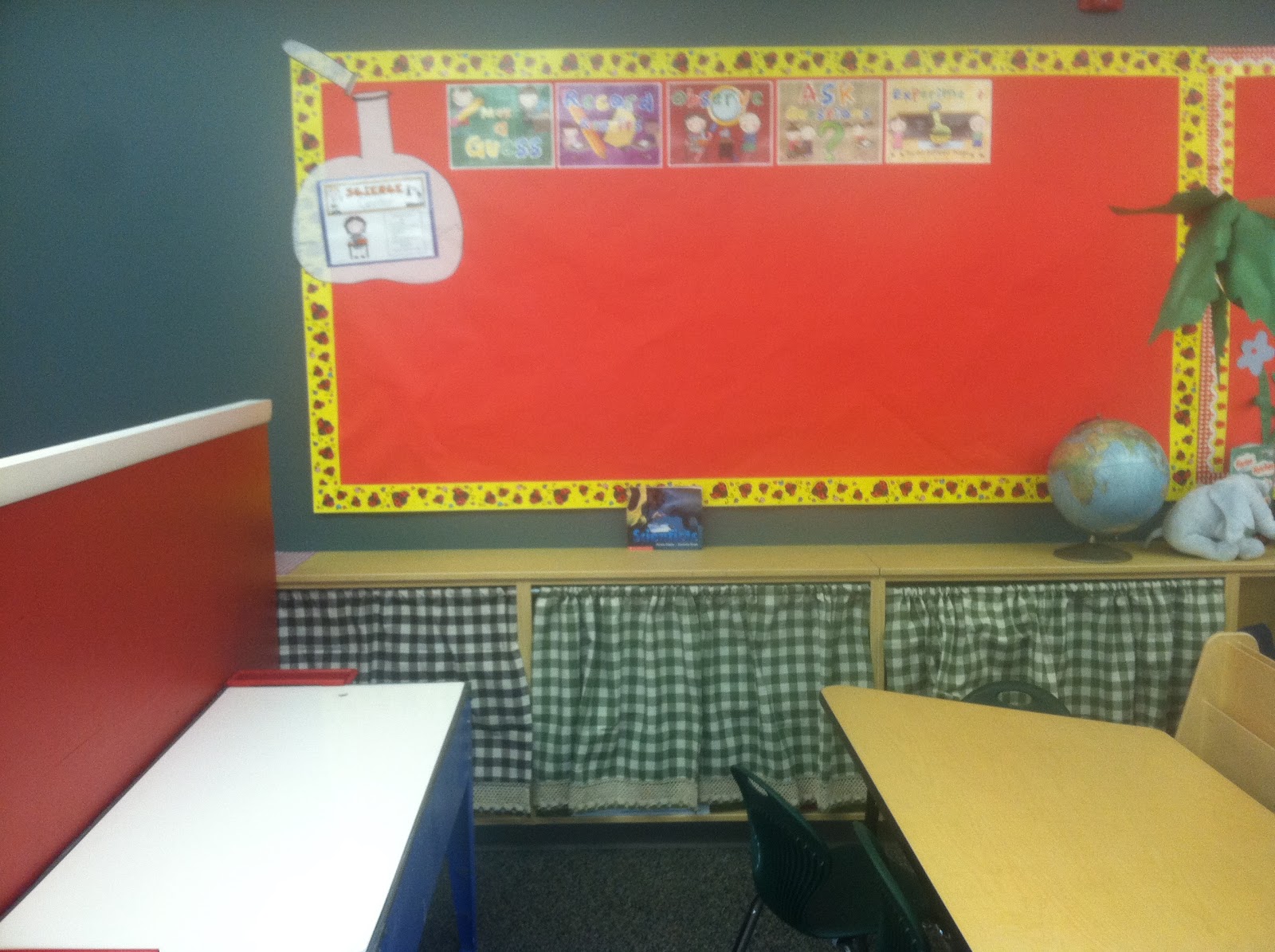
I already knew (and love) the theories of Vygotsky, but it was only by reading this book that I realized the impact that he’s had on education. Before we knew what Vygotsky had discovered about the way children learn, classrooms all looked like the one pictured above. Teachers lectured. Students worked independently. This was because back then, we believed learning to be an entirely internal process. Then Vygotsky came along and we discovered that learning happens in a social context, and language is the key to developing mature mental processes.


And that is why my classroom is so noisy. And that is why it's okay. Because research has shown that language is a key element in a child’s learning. There are times when it is important to listen. Children need to learn when and how to attend to information and how to show respect to a speaker. But children also need to be able to have shared experiences with language in order to build their mental processes. Learning cannot happen in silence. Learning needs conversation, so, a noisy classroom is a learning classroom.

Reading Strategies

Today we focused on Reading Strategy #2, point at the word your voice is saying. We placed a small ladybug sticker on our pointer and taught him how to fly from word to word. Check out our reading strategy posters. They are great for reinforcing early reading strategies.


Common Core Book Study

I am participating in a book study on the Common Core.


This book, “Common Core Curriculum Maps in English Language Grades K-5,” is a terrific guide when implementing the common core standards!

As every kindergarten teacher knows, kindergartners enter school with an extreme range of knowledge. The Common Core Standards have been developed to assist teachers to better meet the needs of this diverse range. This book takes those standards and provides a pacing guide that guides instruction in phonological, phonics, print awareness, fluency, etc. 

Unit 1: A Colorful Time with Rhythm and Rhyme focuses on the first six weeks of kindergarten when students should be introduced to colorful picture books, traditional poetry, playful songs, and rhythmic nursery rhymes. 

We have developed two beginning of the year units to compliment this unit of color and rhyme. Check them out at our online store. You will quickly be on your way to building early readers!


Check out other unit summaries here: 


Blocks in the Classroom

Put blocks in the classroom, and amazing things happen.

The School Bus


Approximately 25 million students across the United States ride the bus to school every day. With so many students depending on the school bus for transportation, it is important to review bus safety rules on a yearly basis. 

In order to address bus safety as efficiently as possible, I post a bus safety bulletin board in my classroom. I can easily go over each rule as I have time...one or two at a time or all points at the same time. We discuss the rules, define words, and even act out some of the rules as time permits. 

While learning about bus safety, I include a few school bus activities to add interest and address some important kindergarten skills. I’ve combined many of these activities into a mini-unit called The School Bus. The unit includes an alphabet and a number game, a guided reader, a writing page, a bus construct, a song poster, and a poster with bus safety rules. Check it out at our online store!
Kathleen


Kindergarten Testing

I have been testing kindergartners all day and it reminds me of this great article. Pressure Cooker Kindergarten.

Thank goodness for Kindergarten Teachers everywhere that are trying hang on to Developmentally Appropriate Practices!


My New Classroom

First off, here is my new school: http://www.youtube.com/watch?v=uI2O0t1s0fE
The school is amazing! My classroom has finally transformed from a giant pile of boxes to a room ready for 5 year olds!
A view from the door.

Drama Center

Science Center

Reading Center

Guided Reading & Writing Center

Whole Group Carpet Area

Listening Center

Technology Center (ipads go on the blank tables.)

Teacher Area

Writing Center

Math Center


Art Center

Whole Group Table Area


Construction Center

Excited about the Technology in the Classroom!

I have always wanted a Document Camera!


Kindergarten Common Core Posters For Math: Black & White


Do you need or want to post your common core standard that will be the focus of your day or lesson? These posters are written as "I can" statements that can be easily read to or by students and quickly understood by adults that enter your classroom.

The best part! These posters are ink friendly. They are created in black and white so that you can mount on any color you would like to add a splash of color. They can also be easily sized to your liking on any copy machine.


Learning To Read is Not a Race


Children must be taught to read sequentially, using developmentally appropriate means.

----------------------------------------------------------------------------------------------------------------------------------
I've seen a lot of hubbub lately touting the teaching of reading at an increasingly early age. First, there was a commercial for a program claiming it could teach your baby to read. Then, I saw an ad for a school whose biggest selling point (according to the ad) was that their school can have your child reading before kindergarten. Apparently, learning to read has become some sort of derby and the children who are ridden there the fastest are the winners. And with the pressure to push academia on our children ever and ever earlier, I can't help but think that this is a pretty damaging attitude to have.

Learning to read is not a race. And the fact is, I could tell you right now how you can teach your baby or toddler to read,  but it won't make your child a life-long reader. This is what anybody who wants to push excessively early reading on your child is trying to sell you: flash cards.  It is a fact that a child can become a reader by memorizing words (teach your child to remember 100 common words such as the, like, and, and and they will appear to be a reader). Now, memorizing common words is important--the most common words in the English language are generally not easily decodable--but there are foundational skills that need to be in place for a child to be a successful reader, and if we push them to the end result to quickly without making sure the necessary skills are in place, there will be problems later on.

In fact, there is something known as the fourth grade slump (sometimes the third grade slump) in which children who were successful academically suddenly encounter problems in third or fourth grade where they are suddenly required to read to learn, instead of being required to learn to read. Children who do not have foundational reading skills will flounder at this requirement because they were shunted off quickly into the skill of reading without being taught how to be a reader.

Because of this, we should be more concerned with reading processes than the reading product. It's not about who's child reads first, it's about laying a good foundation for third grade content reading.  This is the strategy in Finland, where the literacy rate is higher than in the U.S. And we need to be aware that these foundational skills need time to develop. Some children are ready to read at 3 and some children aren't ready until they are 7. Learning to read is a kindergarten through third grade skill.


So if we shouldn't be trying to get our kids reading and reading quickly, then what should we be doing? The focus in the early childhood years should really be on oral language, not written language. In order to be, not just children who can read, but successful readers, children need to be masters of the spoken word. They should talk, they should ask questions, they should play games with the sounds of language, they should listen to rhymes, and they should play. Because learning to read may be challenging, exhilarating, exhausting, frustrating, exciting, daunting, invigorating, and a great many other things. But there is one thing that learning to read is not.

It's not a race.


Learning Center Signs: Dress up the classroom & Inform the Observer!

I love these Learning Center Signs that continually remind and inform not only myself, but anyone that comes into my classroom, what young children are learning in defined areas throughout my classroom each day.

Each sign has an "I Can" or "I Am" statement of learning written with a glimpse into the future of young learners who are encouraged to think, discover, explore, and create.

These signs are $5.00. Copy on cardstock, laminate, and they are ready to go.


ABC Center
Art Center
Block Center
Construction Center
Computer Center
Dramatic Play Center
Discovery Center
Eno Board Center
Fine Motor Center
iPad Center Center
Library Center
Light Table Center
Listening Center
Literacy Center
Math Center
Manipulatives Center
Mimio Center
Music Center
Music and Movement Center
Overhead Center
Pocket Chart Center
Poetry Center
Phonics Center
Puppet Center
Puzzle Center
Puzzle and Game Center
Reading Center
Read the Room Center
Science Center
Sensory Center
Smartboard Center
Social Studies Center
Table Toys Center
Teacher Center
Toy Center
Technology Center
Word Work Center
Write the Room Center
Writing Center
Write the Room Center

Don't see yours? Just ask!


The Importance of Play


I'm in the process of getting ready for school to begin (because I'm starting to have nightmares about not being ready) and I took a field trip to the Alpine Surplus Warehouse. A wonderful place where teachers in our district send the thing they are no longer using for other teachers to snag (or for the district to sell). Sometimes you can find wonderful treasures there: like this student microscope. I tried it out with my three year old. We put a bug on it and it worked beautifully! We magnified the bugs multifaceted eyes and hairy body. I can't wait to put it in the science center!


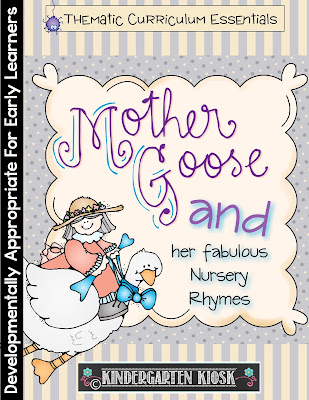
Mother Goose Nursery Rhymes: Thematic Common Core Curriculum Essentials


This Developmentally Appropriate thematic unit, Mother Goose Nursery Rhymes, is strategically linked to the Common Core Standards. It is divided into areas of literature, music, art, literacy, math, worksheets, science, creative writing, word wall, and guided reading. The activities are clearly written, easy to use, and need limited amounts of preparation. The lessons (games or activities) included are scripted. They are written in a format that can be easily taught by the teacher or readily handed off to a parent volunteer or a classroom aide with complete confidence that objectives of the lesson will be reached. 

And, if you are a homeschool mom, don't forget we have 50+ thematic units that will plan your kindergarten year for you!
Table of Contents:
Shared Reading Activities
Mother Goose Rhymes: Saying or Singing Nursery Rhymes
Nursery Rhymes: Sequencing Nursery Rhymes
Hey Diddle Diddle Pocket Chart Activity 
Scripted Literacy Lessons With Independent Options:
Mother Goose Mix-up: Building Working Memory
Humpty Dumpty Rhymes: Matching Rhymes
Blind Mice Chase: Identifying Letters
Mary Goes To School: Using Preposition Words
Independent Activities
Mary’s Letters: Tracing Letters A-Z
Little Lost Lambs: Hunting For Alphabet Letters
Scripted Math Lessons With Independent Options:
Little Bo Peep’s Sheep: Counting Objects to Match Numbers
Under The Haystack: Identifying Shapes
Nursery Rhyme Patterns: Naming and Creating Patterns 
Independent Activities
Hey Diddle Diddle Numbers: Identifying Number Names
Nursery Rhyme Puzzles: Developing Spatial Reasoning Skills
Fetch The Pail: Counting & Writing Numbers
Songs/Fingerplays
Humpty Dumpty
Jack Be Nimble
Mary Had a Little Lamb
Little Bo Peep
Little Boy Blue
Jack and Jill
The Fly & The Bumblebee
Little Miss Muffet
Art Projects
Mary’s Schoolhouse: Construction Project
Mary’s School Portfolio Sample
Humpty Dumpty on a Wall
Writing
Hey Diddle Diddle Prewriting Practice 
My Favorite Nursery Rhyme
Science
Insects & Spiders: Making Comparisons
Guided Reading Books
Mother Goose Land
Class Made Books
Mother Goose Rhymes


Printfriendly